Radical Acceptance: Finding Peace When You Can’t Change What Happened
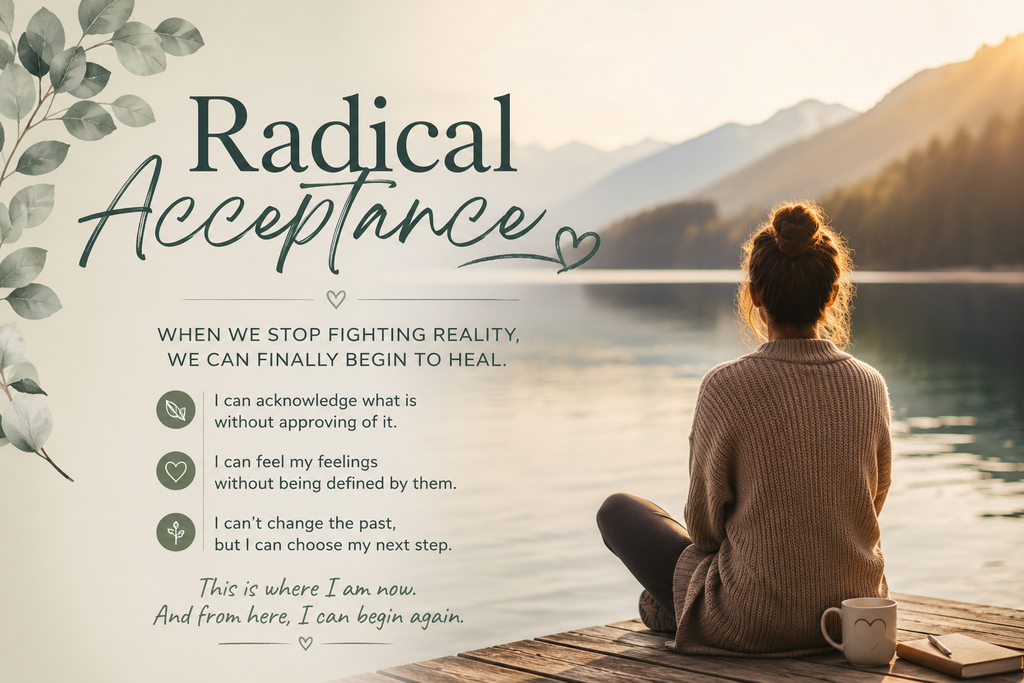
There are moments in life we desperately wish we could change.
A relationship ends. Someone disappoints us. We receive news we never wanted. A plan we counted on falls apart. We make a mistake we cannot undo. Sometimes the pain comes from something happening right now; other times, it comes from something that happened years ago that we are still fighting in our minds.
This shouldn’t have happened.
They shouldn’t have treated me this way.
My life wasn’t supposed to look like this.
Those feelings are understandable. But when reality cannot be changed, continually fighting against the fact that it happened can create a second layer of suffering.
This is where radical acceptance comes in.
What Is Radical Acceptance?
Radical acceptance is the practice of acknowledging reality as it actually is—even when we dislike it, disagree with it, or wish it were different.
The concept is strongly associated with Dialectical Behavior Therapy (DBT), developed by psychologist Marsha Linehan. The word radical means complete or all the way. Radical acceptance means allowing ourselves to recognize the reality of a situation without continually arguing with it internally.
It is the difference between:
“This happened, and I wish it hadn’t.”
and
“This could not have happened. It shouldn’t have happened. I cannot be okay until somehow this is different.”
The first statement contains pain.
The second contains pain plus a battle with reality.
Radical acceptance asks us to consider putting down that battle.
Acceptance Is Not Approval
One of the biggest misconceptions about radical acceptance is that accepting something means saying it was okay.
It doesn’t.
You can accept that someone hurt you without believing their behavior was acceptable.
You can accept the end of a relationship while still wishing it had worked.
You can accept a mistake without excusing it.
You can accept a difficult diagnosis without liking it.
You can accept someone’s behavior and still establish a boundary.
In fact, sometimes accepting reality makes action more possible.
When we stop spending our energy wishing reality were different, we can begin asking a much more useful question:
“Given that this is where I am, what do I want to do next?”
Pain vs. Suffering
Pain is an unavoidable part of being human.
Loss hurts. Rejection hurts. Change can hurt. Disappointment hurts.
But sometimes we unintentionally add suffering to pain through our resistance to what has already happened.
Imagine standing outside during a rainstorm saying:
It shouldn’t be raining.
You might be completely right. Maybe the forecast said sunshine. Maybe you planned an outdoor event. Maybe the timing is terrible.
But arguing with the rain won’t make you any less wet.
Acceptance is noticing:
It’s raining.
And then deciding whether to grab an umbrella, go inside, change your plans—or perhaps even stand in the rain for a while.
Acceptance doesn’t mean you wanted the storm.
It means you have stopped pretending it isn’t raining.
What Radical Acceptance Can Sound Like
Sometimes acceptance begins with very simple language:
- “This is what is happening right now.”
- “I don’t like this, but I acknowledge that it is real.”
- “I cannot change what has already happened.”
- “I can feel disappointed without fighting the fact that this occurred.”
- “I don’t have to understand everything today.”
- “I can choose what I do from here.”
- “Accepting this does not mean approving of it.”
These statements may not immediately make us feel better. That isn’t necessarily the goal.
The goal is to become more grounded in reality so that our next decision can come from clarity rather than resistance.
Acceptance Is Often a Process
Radical acceptance is rarely a single moment where we suddenly say, Okay, I’m over it.
We may accept something at breakfast and find ourselves fighting it again by dinner.
That doesn’t mean we failed.
Sometimes acceptance has to happen dozens—or hundreds—of times.
We notice the resistance.
We acknowledge the emotion.
We return to what is true.
And then we do it again.
Over time, the emotional intensity may begin to loosen.
You Can Accept the Past and Still Change the Future
Perhaps the most powerful part of radical acceptance is recognizing that acceptance and change are not opposites.
Acceptance concerns what is already true.
Change concerns what happens next.
You can say:
This relationship ended—and I can build a meaningful life afterward.
I made a mistake—and I can repair what I can and learn from it.
Someone hurt me—and I can decide what boundaries I need.
My circumstances changed—and I can begin creating a new plan.
Acceptance brings us back to the place where we actually have power: the present moment.
Putting Down the Fight
Sometimes peace doesn’t come because life finally gives us the explanation, apology, outcome, or closure we wanted.
Sometimes peace begins when we realize we no longer need to spend every day arguing with something that has already happened.
Radical acceptance does not erase grief.
It does not eliminate disappointment.
It does not make painful things fair.
But it can create enough space around our pain for something else to exist alongside it—clarity, compassion, hope, and eventually perhaps even peace.
You can wish things had been different.
You can grieve what you lost.
You can decide something was unfair.
And at the same time, you can gently acknowledge:
This is where I am now.
And from here, you can begin deciding where you want to go.